Can I Screed a Floor Myself? When to DIY and When to Call a Contractor
Thinking about screeding a floor yourself in Somerset or Dorset? Here's what the job really involves and why most homeowners call a specialist instead.

The honest answer to "can I screed a floor myself?"
Yes, technically. But the more useful question is whether you should, and for most homeowners in Somerset and Dorset, the answer is almost always no. Not because it is beyond a competent DIYer in terms of effort, but because the margin for error is small and the consequences of getting it wrong are expensive.
This article walks through what floor screeding actually involves, where DIY attempts typically go wrong, and what a professional liquid screed pour looks like compared to a home-mixed attempt. If you are planning an extension, renovation or new build in Taunton, Yeovil, Bridgwater or Weston-super-Mare, this should help you make a clear-headed decision.
What does screeding a floor actually involve?
Screed is the layer laid on top of a concrete sub-floor to create a smooth, level surface ready for tiles, wood, vinyl or any other floor finish. It sits between the structural floor and whatever you see when you walk in.
A traditional sand and cement screed is mixed on site, roughly one part cement to three or four parts sharp sand, then applied by hand and levelled with a straight-edge. That sounds straightforward. In practice, getting the mix consistent, the depth even, the surface flat and the whole floor level across a large area takes real skill and a lot of physical effort.
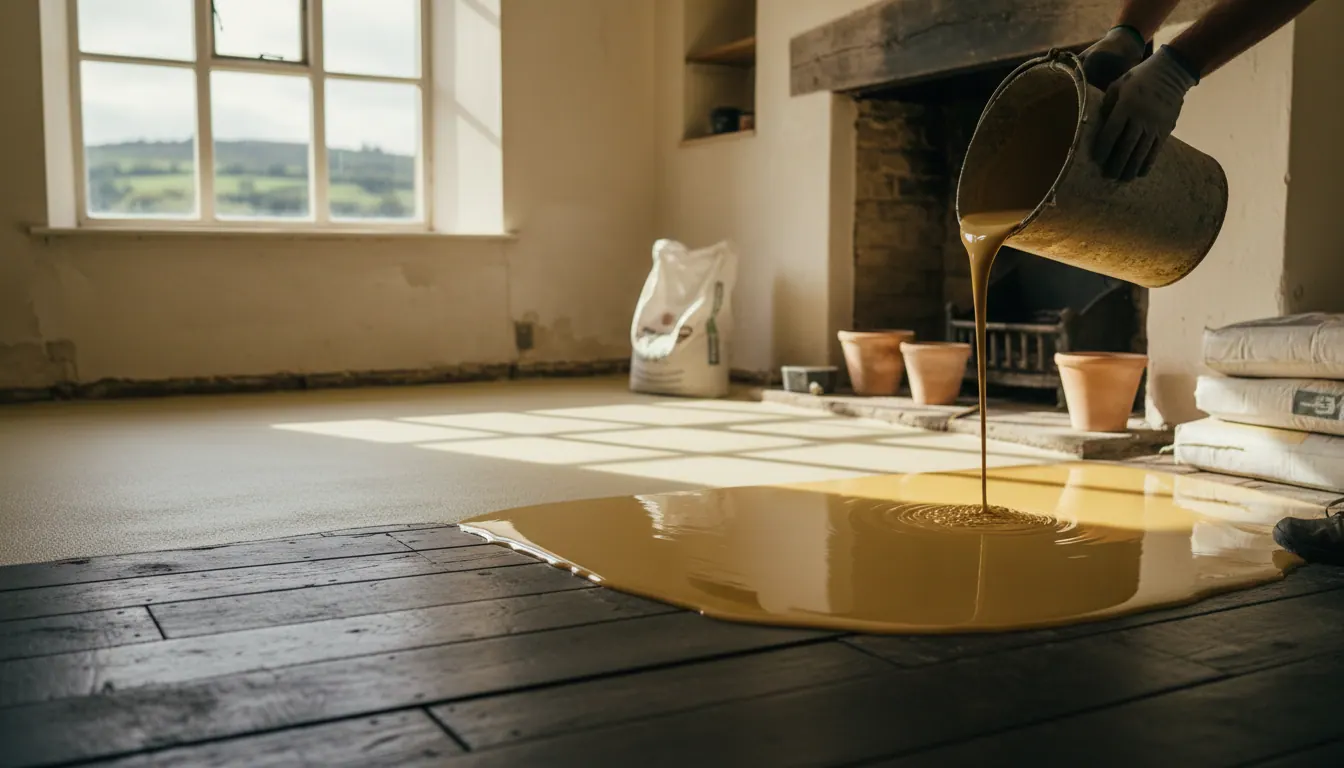
Liquid screed (also called flowing screed or calcium sulphate screed) is different. It is pumped into the room from a lorry-mounted pump outside, flows across the floor under its own weight and self-levels to a flat finish. You cannot mix liquid screed yourself at home. It is a factory-batched product delivered and installed by a specialist contractor. That rules out the DIY question entirely for liquid screed.
Where DIY sand and cement screed usually goes wrong
If someone asks "can I make my own screed?", they are almost always thinking about a sand and cement mix. Here is where it tends to fall apart:
Inconsistent mix. Screed mixed by hand or in a small drum mixer varies batch to batch. Variations in water content, even small ones, affect strength and drying. A floor mixed across twenty separate batches will not behave as one uniform slab.
Uneven depth. Screed needs to be laid at a consistent depth across the whole floor. Too thin in places and it cracks. Too thick and drying times stretch significantly. Maintaining that consistency across a whole room, let alone a whole ground floor, is harder than it looks.
Poor flatness. A truly flat floor requires a good eye, the right tools and practice. A floor that looks flat to the naked eye can still have high and low spots of several millimetres. That matters when you come to lay tiles or engineered wood, where any movement in the substrate will eventually show.
Cracking. Sand and cement screed shrinks as it dries. Without the right mix, the right depth, the right curing conditions and the right jointing, cracking is common. Hairline cracks in a screed may not be structurally serious, but they can telegraph through floor tiles and cause grout lines to fail.
Drying time. A hand-mixed sand and cement screed takes roughly one millimetre of depth per day to dry as a rule of thumb, though actual conditions vary. A 75 mm screed could take over two months before floor finishes can go down. That has real implications for your build programme.
For more on how drying and floor finish timings work in practice, our article on how long until you can lay tiles after floor screeding covers the timeline in detail.
What about self-levelling compound? Is that the same thing?
No. Self-levelling compound (sometimes called self-levelling screed or floor leveller) is a bagged product you mix with water and pour over an existing floor to skim out minor imperfections. It is typically used in thin layers, often just a few millimetres, to flatten a slightly uneven surface before laying a floor finish.
It is not the same as a structural screed. You would not use it to fill the full depth between a concrete sub-floor and your finished floor level. It is a finishing product, not a base layer.
Before using a self-levelling compound, the existing floor needs to be clean, sound and primed. Loose material, contamination or a dusty surface will stop it bonding. If the floor beneath is genuinely uneven rather than just slightly rough, a thin skim of leveller will not solve the problem. It will follow the undulations rather than correct them.
If you are dealing with a genuinely uneven floor, especially in an older property, our article on liquid screed for uneven floors in older Somerset homes explains the options in more depth.
What a professional liquid screed pour looks like
When we arrive on site, the floor preparation needs to be complete: insulation laid, damp-proof membrane in place, perimeter edge strip fixed around the walls and any underfloor heating pipes laid and pressure-tested by your heating installer.
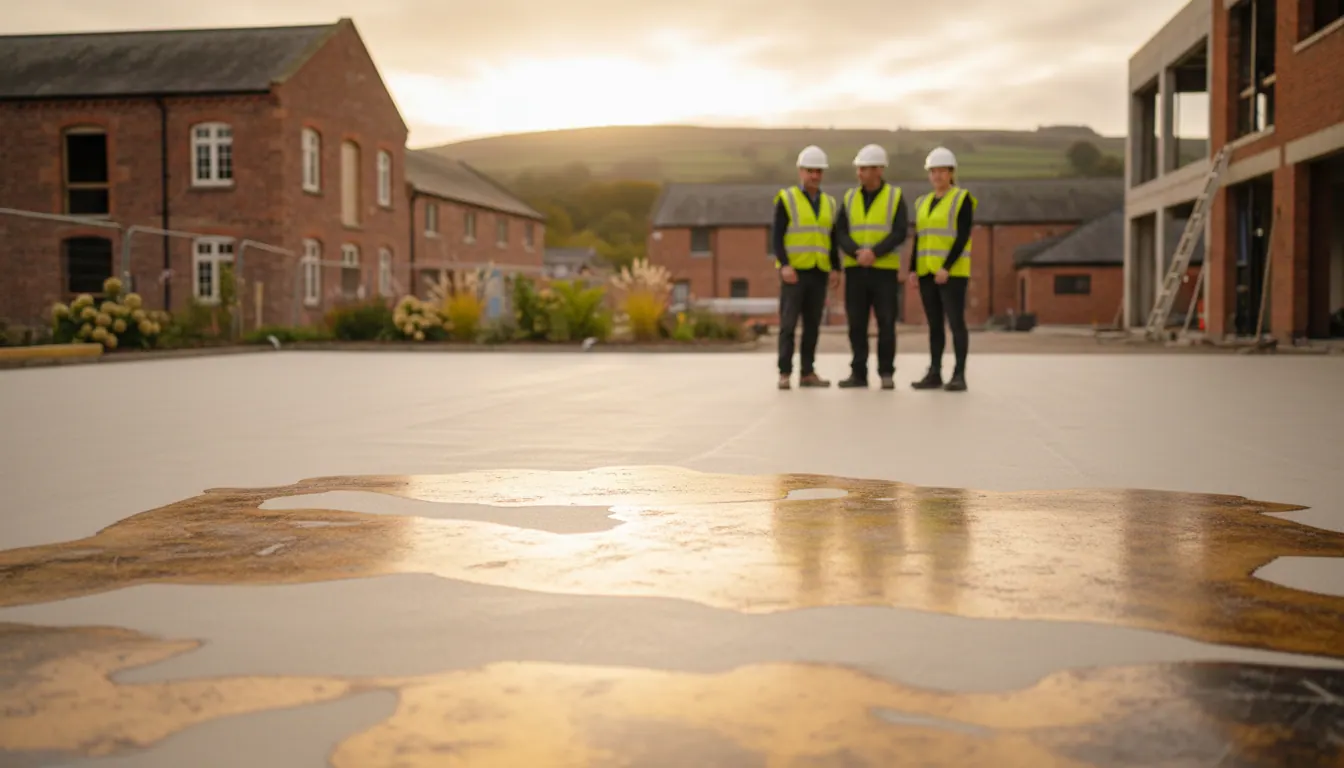
We can carry out the floor preparation ourselves if needed, including laying the insulation, membrane and perimeter edging. Once the floor is ready, the pump hose comes through a window or door, and the screed flows into the room. We rake it out and check levels as we go. For a typical ground floor, the pour itself is fast. The screed finds its own level, which is exactly the point.
The result is a flat, consistent floor across the whole area, without joints in most cases, with no batch-to-batch variation and no risk of the uneven hand-finishing you get with a DIY attempt.
What our customers say
Josh, one of our recent customers, put it simply:
"Really happy with the work. The finish was spot on and you can tell a lot of care and attention went into getting everything right. Turned up when he said he would, worked hard and left everything tidy afterwards. Would definitely recommend to anyone looking for a reliable and professional screeding service."
That "finish was spot on" comment matters. A flat, consistent finish is not just about aesthetics. It is what allows your floor covering to go down correctly and last.
Is there any part of the job a homeowner can do themselves?
Preparation work is the one area where a capable homeowner can make a genuine contribution. Clearing the floor, removing old flooring, making sure the sub-floor is clean and sound, and having the underfloor heating pipes tested and signed off by your heating engineer are all things you can do before we arrive. The more prepared the floor is, the smoother the pour goes.
What you cannot do yourself is the screed pour itself, at least not with liquid screed. And if you are working with underfloor heating, liquid screed is almost always the better choice anyway, because it flows around the pipes and encases them fully, giving better heat transfer than a hand-applied mix. Our guide on underfloor heating and liquid screed explains why that matters.
Frequently asked questions
Can I mix my own screed at home? You can mix a sand and cement screed yourself using a mixer, sharp sand and cement, but achieving a consistent mix across a whole floor is genuinely difficult. Variations in water content, aggregate ratio and application depth lead to cracking, weak spots and an uneven finish. Liquid screed cannot be made at home. It is factory-batched and delivered by a specialist contractor.
What do I need to put down before a liquid screed pour? The floor needs insulation (for thermal performance and to meet building regulations), a damp-proof membrane, and a perimeter edge strip around the walls. If underfloor heating is part of the project, the pipes need to be laid and pressure-tested before we pour. We can handle the preparation stage ourselves if you need us to.
What is the best way to level a very uneven floor? It depends on how uneven the floor is. A self-levelling compound works for minor imperfections of a few millimetres. For a floor that is significantly out of level, especially in an older property, a full liquid screed pour is the right approach. It flows to its own level across the whole area and corrects larger variations consistently.
Can you pour screed over existing concrete? Yes, in most cases. The existing concrete sub-floor needs to be structurally sound, clean and free of contamination. Loose material, paint or grease will prevent bonding. We assess the sub-floor as part of the preparation process. If the existing concrete is in poor condition, that needs addressing before any screed goes down.
Ready to get a quote?
If you are planning a renovation, extension or new build across Somerset or Dorset, including Bridgwater, Taunton, Yeovil or Weston-super-Mare, we are happy to talk through what your floor needs and give you a free quotation. Just get in touch with us with your floor area and location and we will take it from there.