Liquid Screed vs Sand and Cement: What Builders in Taunton and Yeovil Actually Need to Know
Choosing between liquid screed and sand and cement for your next build? We explain the real differences for builders and homeowners across Somerset and Dorset.

The choice that shapes everything that comes after
Pick the wrong screed type and you create problems for every trade that follows you. Tiles that won't bond. Underfloor heating that doesn't perform. Floors that take weeks longer to dry than the programme allows. For builders and homeowners across Somerset and Dorset, the decision between liquid screed and traditional sand and cement screed is one of the most practical choices on any build, and it's worth understanding properly before you commit.
We get asked about this regularly, whether it's a homeowner in Taunton planning a ground-floor renovation or a site manager in Yeovil juggling a new-build programme. So here is a straightforward comparison, written for people who need to make a real decision, not just browse a comparison table.
What each type of screed actually is
Sand and cement screed is the traditional option. It's a semi-dry mix of sharp sand and cement, laid by hand and tamped or floated level. It has been used on floors for generations. It works. But it requires skilled labour to get a genuinely flat finish, and it comes with some limitations that matter on modern builds.
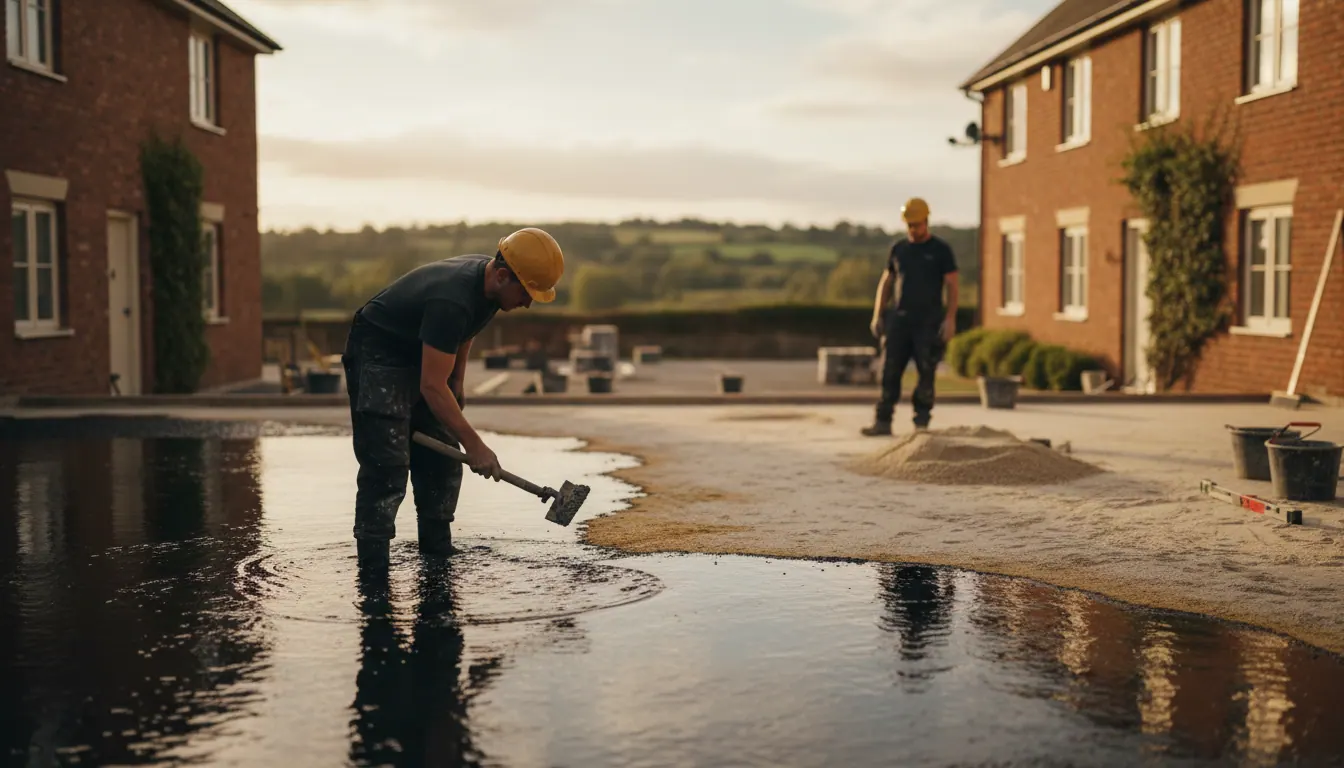
Liquid screed (sometimes called flowing screed or self-levelling screed) is a pumpable material that is poured onto the floor and flows to find its own level. It is typically gypsum-based (known as anhydrite screed) or cement-based, and it is mixed off-site or on-site and pumped through a hose. The result is a much flatter, more consistent surface, achieved faster and with fewer operatives.
Both are floor screeds. Both sit on top of your structural slab or beam-and-block floor and provide the finished level surface that your floor covering sits on. The differences are in how they behave, how long they take to dry, and what jobs they suit best.
Where liquid screed has a clear advantage
For most modern builds across Somerset and Dorset, liquid screed is the more practical choice. Here's why builders and self-builders tend to prefer it.
Speed of installation. A liquid screed pour over a large floor area can be completed in a fraction of the time it takes to lay sand and cement by hand. For a new build or an extension where the programme matters, that's significant.
Flatness. Because liquid screed flows, it self-levels to a genuinely flat finish. Sand and cement relies on the skill of the operative. Liquid screed removes much of that variable. For tiled floors or engineered timber, a flat substrate is essential.
Underfloor heating compatibility. Liquid screed encapsulates underfloor heating pipes far more effectively than sand and cement. It flows around the pipes and eliminates air pockets, which means better thermal transfer and more even heat distribution. If you're laying UFH (underfloor heating), liquid screed is the stronger choice. We cover this in more detail in our guide to underfloor heating and liquid screed.
Thinner section. Liquid screed can typically be laid at a shallower depth than sand and cement. On renovations where floor build-up is tight, particularly in older properties where door heights and step levels are already fixed, that matters.
Less labour on site. A liquid screed pour requires fewer people and less physical effort than hand-laying a sand and cement mix across a large floor.
Where sand and cement still has a role
Sand and cement screed is not obsolete. There are situations where it remains appropriate.
Small, awkward areas where a pump hose cannot easily reach. Steps, upstands and localised repairs. Areas where the floor will receive heavy point loads and a thicker, stiffer section is specified. Some builders also prefer it for smaller domestic jobs where the economics of mobilising a pump do not stack up.
It is also worth noting that sand and cement screed can be laid on walls (as a render) and used in applications where liquid screed would not be appropriate. The two materials are not always in direct competition.
The drying question: what builders need to plan for
This is where the comparison gets nuanced. Both types of screed need time to dry before you can lay floor coverings. Rush that, and you risk adhesive failure, moisture-related damage to timber floors, and a very unhappy client.
Liquid screed generally dries faster than sand and cement at equivalent depths, partly because it is laid thinner and partly because of its composition. But "faster" is relative. You still need to allow proper drying time, and that time depends on depth, temperature, ventilation and whether forced drying (using dehumidifiers and air movement) is employed.
For a builder planning a programme in Bridgwater or Weston-super-Mare, the key point is this: build drying time into your schedule from the day of the pour. Do not assume the screed will be ready for floor finishes by the time the tiler arrives. For a more detailed look at timelines, our article on how long until you can lay tiles after floor screeding walks through what to expect.
What Josh found on his job
One of our customers, Josh, put it simply:
"Really happy with the work. The finish was spot on and you can tell a lot of care and attention went into getting everything right. Turned up when he said he would, worked hard and left everything tidy afterwards. Would definitely recommend to anyone looking for a reliable and professional screeding service."
That finish Josh mentions is not accidental. It comes from getting the preparation right before the pour and from understanding the material. Liquid screed that is poured onto a poorly prepared substrate, with insulation not properly fixed or perimeter edging missing, will not perform as it should. The screed itself is only part of the result.
What builders specifically need to consider
If you are a builder or contractor managing a project in Somerset or Dorset, here are the practical questions to work through before specifying your screed.
- What floor area are you screeding? Liquid screed makes most sense from a certain floor size upwards. For very small areas, sand and cement may be more practical.
- Is there underfloor heating? If yes, liquid screed is almost always the right choice.
- What is the floor build-up allowance? Tight on height? Liquid screed's thinner section may be the deciding factor.
- What floor finish is going on top? Large-format tiles, engineered timber and luxury vinyl tile all benefit from the flatter substrate that liquid screed provides.
- Who is doing the floor preparation? We can handle the full prep, including laying insulation, membrane and perimeter edge strip, before the pour. That removes a coordination headache from your programme.
For a broader look at what the screeding process involves on a typical build, our article on whether screeding is a big job is a useful starting point.
Frequently asked questions
Is screed as strong as concrete?
No. Screed and concrete are different materials with different jobs. Concrete is a structural material, designed to carry loads. Screed is a finishing layer that sits on top of the structure and provides a flat, level surface for floor coverings. Screed is not load-bearing in the structural sense. Liquid screed is strong enough for its purpose, but you would not use it in place of a structural slab.
How deep does liquid screed need to be?
The required depth depends on the application. Liquid screed over underfloor heating needs to cover the pipes adequately and allow the heat to distribute evenly. Unbonded liquid screed (laid on insulation with no mechanical bond to the substrate) needs a greater depth than bonded screed. The exact specification depends on your floor construction and what is going on top. We assess each job individually and advise accordingly when we quote.
What's the difference between screed and mortar?
They are both cement-based mixes, but they serve different purposes. Mortar is used for bedding and bonding, such as laying bricks, setting tiles or pointing. Floor screed is used specifically to create a flat, level surface over a structural floor. The mix ratios differ, and so do the working properties. Using mortar as a floor screed would give a poor result, and vice versa.
Can I use liquid screed in an older property where the floors are uneven?
Yes, and it can be a very effective solution. Liquid screed flows to find its own level, which makes it well suited to floors that have settled unevenly over time. The key is ensuring the substrate is properly prepared and that the depth of screed is appropriate for the level variation. We cover this in detail in our guide to liquid screed for uneven floors in older Somerset homes.
Ready to discuss your project?
If you are a builder, contractor or homeowner in Somerset or Dorset with a floor to screed, we are happy to talk through what suits your build. Tell us your floor area, your location and what you're working with, and we'll give you a straight answer and a free quotation. Get in touch with us and we'll take it from there.
Need a floor screeding?
Get in touch- Liquid Screed for Uneven Floors in Older Somerset Homes: How It Levels Problem Floors
- Is Screeding a Floor a Big Job? What Homeowners and Builders Need to Know
- How Long Until You Can Lay Tiles After Floor Screeding? A Bridgwater Homeowner's Timeline
- Underfloor Heating and Liquid Screed: A Somerset Guide